Building the Subconscious: A Week in the Woods with Cascadia Running Camp
The quiet hours between the physical output.
We kicked things off with thunder, lightning, and a torrential downpour. It felt oddly appropriate. Cascadia Running Camp wasn't designed to be comfortable. Set up in a wide-open field at the edge of the woods without running water, the inaugural Washington running camp asked athletes to disconnect from the noise and focus on something much harder to train: the mind behind the miles.
Campers arrived car by car. As director Jena Winger checked them in, counselors handed out gear bags, shirts, and fresh pairs of Brooks trainers. I sent my kid off to set up his tent and acclimate to the cross country camp, got our own family site squared away, and immediately grabbed my gear.
Base camp reality: drying out gear after a first-day downpour.
Brooks Running outfitted the camp, making sure every athlete walked away with a fresh pair of miles.
The Unvarnished Start
I found Jena just as the group of high school distance runners was prepping for their first run. I dashed back, grabbed a second camera, snapped a few group photos at the trailhead, and then sprinted ahead of the pack to get into position. After waiting in the quiet of the woods and second-guessing my route, I finally heard the rhythm of feet and chatter coming down the dirt path. I kicked off my coverage with action shots right out of the gate, picking up a couple of miles of my own in the process.
It became clear this camp was chasing something far beyond mileage. That first evening, campers gathered after dinner to listen to Jena break down mental strategy. She talked about how the brain protects you, how to coach the conscious mind, and how to build subconscious belief through daily work.
Director and co-founder Jena Winger kicks off the camp's mental strategy curriculum after the first run.
The rhythm for the rest of the week was set to music drifting across the camp every morning: wake up, grab a snack, warm up, run. But the real heavy lifting happened in the quiet hours between the physical output.
Beyond the Mileage
One of the most striking moments came during a session on nutrition and REDs (Relative Energy Deficiency in Sport) led by Liza Rickey. I sat in, curious how she’d navigate the topic with teenagers. Her message was uncompromising: eat, no matter what. Snack time was heavily integrated into the schedule, and kids were encouraged to grab whatever they needed—candy, fats, anything—to fuel the machine rather than restrict it.
“Eat, no matter what.”
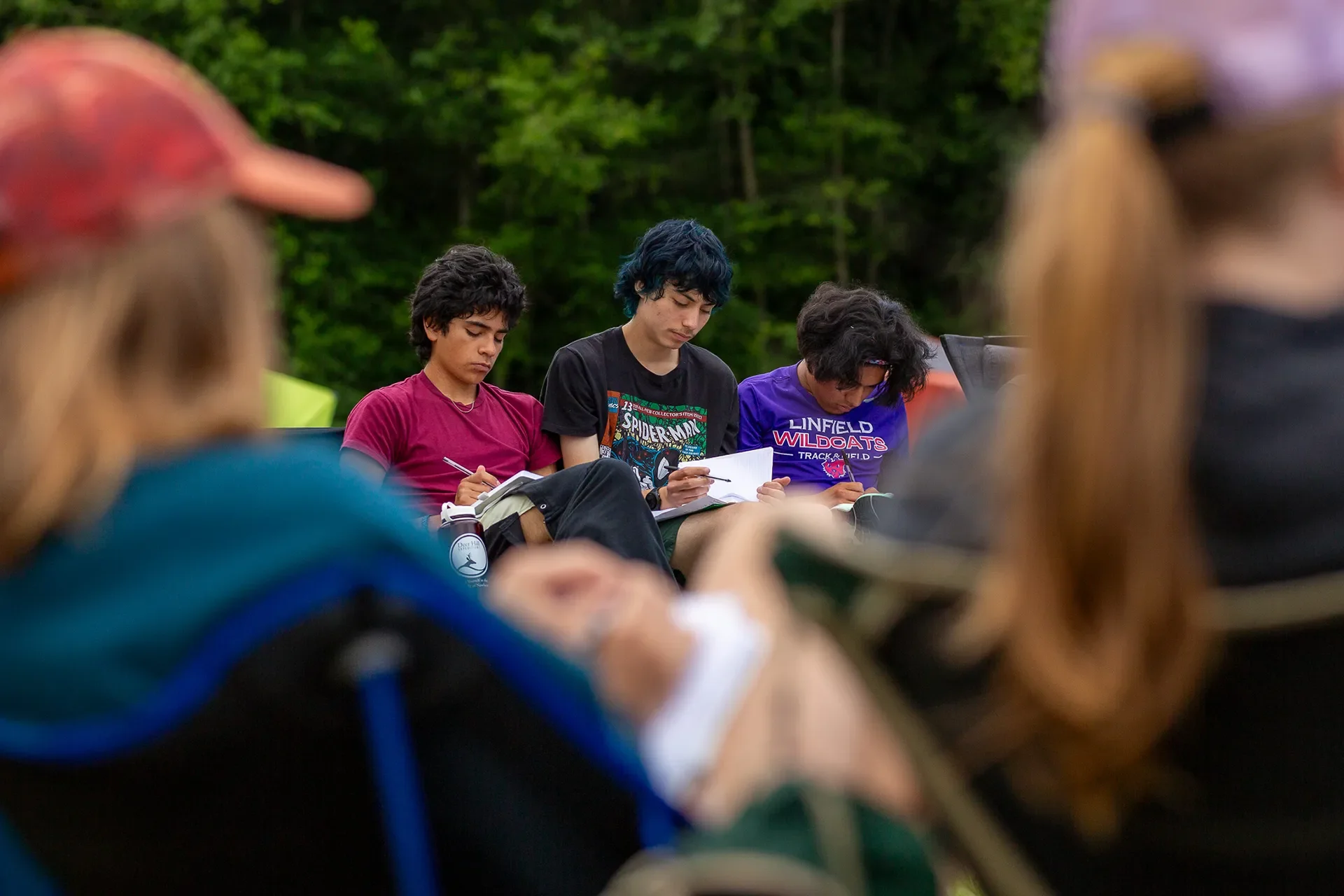
Athletes putting in the mental groundwork during a group discussion.
The focus wasn't just on the food, but the reflection around it. Campers were asked to recognize what under-fueling actually feels like in their own bodies. The conversation even touched on the quiet, tangled social awkwardness of needing to eat more than the friend sitting next to you. Watching athletes and coaches confront that dynamic together, in real-time, felt like a vital conversation that most team environments completely ignore.
The camp balanced the physical grind with creative and educational counterweights, from acrylic painting to strength and mobility sessions with Deresse. During a quick snack run into Port Gamble, I was reminded just how isolated the camp really was. Within minutes, the quiet forest gave way to storefronts and tourists before disappearing again behind us on the walk back.
A quick snack run into Port Gamble served as a sudden shift in scenery from the deep woods of the base camp.
Later that evening, guest speakers pushed the athletes to see the broader landscape of the sport. Lake Washington’s Alexa Matora broke down the realities of NIL as a recent high school graduate, while Caroline Daniel of Brooks Running offered the perspective of a longtime industry veteran. Hearing one voice currently living the shift, paired with another who has watched the landscape evolve over the years, surfaced the kind of granular insights you can’t just Google.
Lake Washington graduate Alexa Matora and Brooks' Caroline Daniel break down the evolving realities of NIL and sports marketing.
Shared Distance
Field Notes — Port Gamble, WA
“There is something profoundly unifying about sharing distance.”
On the third morning, the camp tackled the long run—11 to 12 miles through the trails. What stuck with me had nothing to do with who crossed the invisible finish line first. I’ve logged plenty of miles with friends and strangers alike, and there is something profoundly unifying about sharing distance. You can run in silence or talk the whole way through, but just being on the same journey does the work.
Kingston standouts Coen Van Vliet and Emma Grice recovering after 12 miles through the trails.
Poulsbo Running’s Jonathan Erickson breaks down proper footwear mechanics on the final morning.
Brooks Beasts coach Drew Windle shares insights from the professional circuit.
From the field
The miles mattered.
The mindset mattered more.
The Groundwork
Associate Director and co-founder Elizabeth Carey putting in the physical groundwork and sharing the distance alongside the athletes deep in the Port Gamble trails.
Director Jena Winger takes in the final day of camp in a custom tie-dye shirt made earlier in the week.
By our final morning, as the athletes returned from a shakeout run, I found myself talking with Jena and associate director Elizabeth Carey. They were already tearing down the week in their heads—comparing notes on what to tweak, what to cut, and what had worked perfectly. For a first-year launch, the entire operation felt remarkably polished. Both of them are deeply rooted in the Pacific Northwest running community, and it showed.
Nothing about Cascadia Running Camp read as a debut. The speakers, the environment, and the curriculum all pointed at a holistic philosophy: this wasn't just about winning or raw power. It was about getting mentally grounded, listening to your body, and taking care of yourself from the inside out.
As the last sunrise warmed my tent, I was definitely ready for a shower. But I left convinced the most important work of the week hadn't happened on the trails at all. It happened in the conversations after dinner, around notebooks, during snack breaks, and in the quiet hours between the physical output. The miles mattered. The mindset mattered more.
Pure energy on the final morning at base camp.
The final day. The groundwork has been laid.