Running Wild on Whidbey: Capturing Heritage and History at Fort Casey
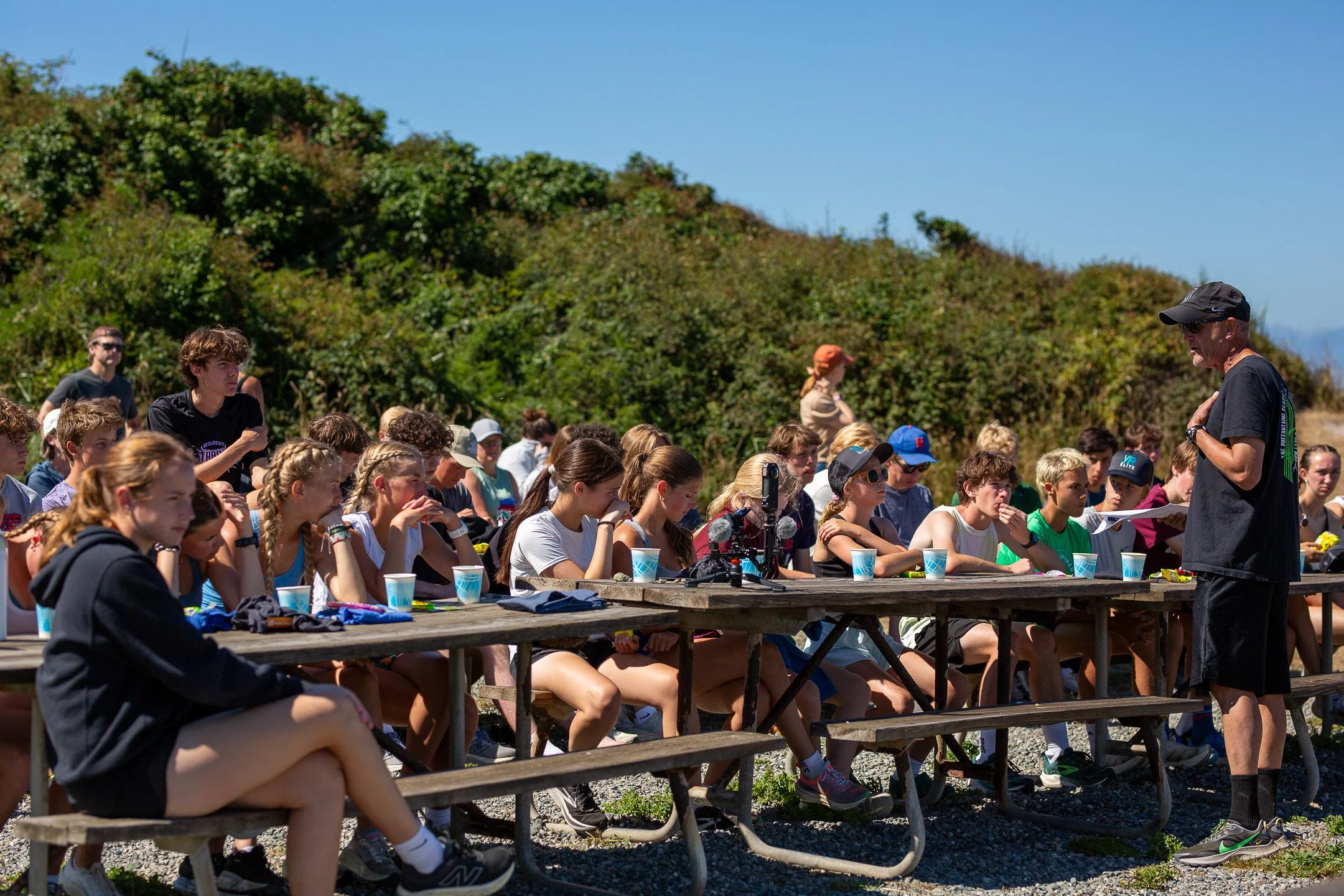
Youth Runner Magazine publisher Dan Kesterson addressing campers and coaches at the outdoor picnic tables following the Doris Heritage Camp Classic race.
When Youth Runner Magazine recently took over the Whidbey Island Running Camp at Fort Casey, owner Dan Kesterson approached me about covering the event. He needed dynamic marketing material and website updates—the exact kind of storytelling assignment I love. There is something incredibly rewarding about bringing a camp to life, capturing the day-to-day experience so that potential campers and their families can truly envision themselves there when making their summer training decisions. My goal was to paint an honest, vivid picture of what makes this camp so special.
Welcoming campers and visitors to the historic Camp Casey Conference Center in Coupeville.
Flags flying over the historic Camp Casey Conference Center grounds.
Coast Salish Roots & The Doris Heritage Legacy
Indigenous Lookout Runners of Admiralty Head
One of my favorite aspects of the week was uncovering the rich history surrounding Fort Casey. Long before the military bunkers or the running camp were built, these lands were the traditional territory of Coast Salish Indigenous people—including the Swinomish Indian Tribal Community, Tulalip Tribes, Suquamish Tribe, and Lummi Nation—who stewarded these prairies and shores for millennia. In a beautiful historical echo for a running camp, Admiralty Head originally served as an Indigenous lookout; when incoming raiders were spotted, specialized runners would carry the news to nearby villages to warn others.
The Doris Heritage Pioneer Era
In 1960, Doris Heritage first visited this deeply historic ground as a Seattle Pacific freshman, arriving by boat. She would later inherit the Falcon Running Camp at Casey from its founder, PE Department Chair Dr. Ken Forman. Her legacy is deeply woven into the fabric of the Washington running community. As an elite competitor, coach, camp director, and a true pioneer in women’s distance running, Doris has left an indelible mark on hundreds of athletes—many of whom are now coaching the next generation of runners.
Gonzaga Head Coach Pat Tyson and Jackson High School Coach Traci Bianchini speak with pioneer distance runner Doris Heritage following a screening of her biographical documentary, Last Lap.
Day 1: Shakeout Runs and The Legacy of Doris Heritage
Day 1 kicked off with camper registration followed immediately by a quick shakeout run, throwing the athletes straight into the very activity they would spend the week honing. Afterward, everyone gathered in one of Fort Casey’s historic meeting halls. There, coaches—including Gonzaga University’s Pat Tyson and Jackson High School’s Eric Hruschka and Traci Bianchini—spoke briefly about Doris’s monumental legacy. After introducing Doris to the crowd, everyone settled in to watch Last Lap, an inspiring documentary by Kinetic Village that chronicles her pioneering journey from a barefoot girl running on the beach to a world-renowned running legend who set the pace for generations of female athletes.
Digging into immediate, quad-burning elevation along the bluff trail overlooking Admiralty Inlet.
Day 2: The Legendary Bluff Run at Ebey's Landing
Day 2 started early, just as the sun was peeking over the horizon. The runners shook off sleep, gathered, and headed out for the camp's signature route: the legendary Bluff Run. The course took them a couple of miles down to the beach, then up a steep trail to the bluffs where they had to digest some vertical, before heading back down for a scenic stretch along the shoreline.
Early Morning Scouting & Coastal Wildlife
I arrived well before the runners to scout the area. Waiting in the quiet morning air allowed me to take in the spectacular scenery: ospreys darting in and out of fields that spanned as far as the eye could see, seagulls squawking along the shore, and an eagle or two soaring overhead. Sitting there watching a cargo ship glide past, I noticed a snail, then another, then another. It was a perfect reminder that in a place so rich with wildlife, you have to slow down to truly take it in.
A reminder to slow down and take in the coastal ecosystem: a snail along the bluff trail at Fort Casey State Park before the morning run.
An American Bald Eagle soaring low over Admiralty Inlet off the bluffs at Fort Casey State Park.
A cargo ship glides across Admiralty Inlet toward Puget Sound, viewed from the bluffs above Camp Casey during morning scouting.
Climbing the Bluff Trail
After settling on my angles and composition, I spotted a small group of runners who had driven up early. From my vantage point high on the bluff, they looked like tiny ants warming up in the parking lot below. When they hit the trail, there was no easing into it—just immediate, quad-burning elevation. Soon, a stream of runners emerged from the tree-covered road, winding through the parking lot and spilling onto the trail, climbing toward my lens.
Mid-Week Challenges & The Port Townsend Ferry Trip
The days that followed flew by in a blur of mileage, team-building activities, and a ferry trip to Port Townsend. Campers were divided into teams, competing all week in everything from training challenges to a sandcastle-building contest on the beach, with the high-scoring groups taking home prizes on the final day.
Whidbey Island Running Camp athletes and coaches gathered on the deck of the Washington State Ferry as it approaches Port Townsend across Admiralty Inlet.
The Doris Heritage Camp Classic: 2.9 Miles of Grit
On the final day, athletes and their families gathered for the Doris Heritage Camp Classic. Clocking in at 2.9 miles—just short of a traditional 5K—the race kicked off on the hottest afternoon of the week. With the course nearly 100% exposed, there was nowhere to hide from the sun. Still, it was a blast to watch these kids compete again. The race offered an exciting sneak peek of some of the state's top high school talent racing in a low-stakes environment where only bragging rights were on the line.
Looking Ahead to the WIAA Cross Country Season
From my perspective behind the lens, the camp was an absolute success. The runners were challenged, but clearly having the time of their lives. As the fall cross-country season kicks off, I’m looking forward to reconnecting with these campers and coaches when our paths cross at invitationals across the state.
A Columbian black-tailed deer doe and her fawn bounding across the parade grounds outside Camp Casey's historic officers' quarters.
Historical Side Note: Fort Casey & Camp Casey Legacy
The historic military fortifications and coastal grounds of Fort Casey State Park in Coupeville, Washington.
Military Foundation (1897–1954): The U.S. military broke ground on Fort Casey in 1897 along Whidbey Island, named after Brigadier General Thomas Lincoln Casey. Alongside Fort Worden in Port Townsend and Fort Flagler on Marrowstone Island, Fort Casey formed the "Triangle of Fire" guarding Puget Sound. In 1954, the Army declared the site surplus.
Seattle Pacific Acquisition (1956): In 1956, Seattle Pacific College President C. Hoyt Watson led the purchase of the northern 80 acres (dubbed "Watson's Folly" by skeptics), eventually expanding to 300 acres for the Camp Casey Conference Center. The remaining battery grounds became Fort Casey State Park.
Forman, Shockey & The Falcon Running Camp: PE Department Chair Dr. Ken Forman found the facilities "filled with rubble" upon arrival. Dr. Forman and Camp Casey's first director, Charles Shockey, worked with student volunteers to clear the site, build softball fields, nature trails, and campsites. Dr. Forman founded the original Falcon Running Camp at Casey, which Doris Heritage later inherited and ran for over 40 years. Heritage famously called Ebey’s Landing Trail from Casey "absolutely the best place to run in the whole world."
Academic & Athletic Traditions: In 1972, soccer coach Cliff McCrath hosted the first Northwest Soccer Camp at Camp Casey. During the 1970s, students participated in the "Casey Quarter" field study (ecology, geology, literature). In summer 1991, student employees founded "The Thomas Parker Society" by reading classic literature aloud by candlelight in the Thomas Parker bunker—a tradition continuing in Seattle today.
(Historical reference data sourced from Seattle Pacific University Response Magazine — War and Peace by Jeffrey Overstreet).