The Kinetic Architecture of a 'No'
Olympia High school male athletes begin the 1,600-meter run at a track and field competition in Olympia, WA. The athletes are positioned in a starting stance as they accelerate from the line. Commercial sports and editorial photography engineered by Russell Moore Photography in Olympia, WA.
Four days of shooting. Hours of editing. Countless proposals. And at the end of it: a very big no thanks.
By Wednesday afternoon, the fatigue was heavy. I considered skipping the local track meet entirely. It wasn’t a lack of desire to shoot; it was the mental friction of a day spent fighting for my creative worth, digging up details about a rejected proposal that genuinely stung.
But instead of staying home and letting that rejection be the defining note of the day, I decided I needed a different kind of friction. A sort of creative penance. If the professional world was going to tell me my vision didn't fit their easily digestible package, I was going to make the physical process of shooting as difficult and analog as possible just to prove to myself that my eye still worked.
I stripped away the modern polish, left the autofocus at home, and grabbed my Canon 1DS MKIII paired with a vintage, manual-focus Super-Takumar 50mm.
I arrived at the track harnessed up with three cameras. My 5D MKIII and 1DX were strapped to me, but I never touched them. They just came along for the ride to watch their great-grandfather get some playing time.
A female track athlete holds a baton while positioned in the starting blocks for the 4x200m relay at Olympia High School. The sprinter prepares for the start of the race during a track and field competition in Olympia, Washington. Commercial sports and editorial photography engineered by Russell Moore Photography in Olympia, WA.
Shooting track and field with a manual lens is a high-wire act. I started with the 4x200 relay, hoping the static start would give me an edge. I nailed one frame, but the moment the athletes exploded from the blocks, the reality of manually tracking a sprinter on a 1DS sensor set in. It was a brutal, beautiful limitation. My brain had to focus so intensely on the mechanics of the glass that there was no room left to stress over business.
The 3200m was where the workflow finally clicked. Eight loops. A strung out pack. I stopped trying to chase the runners and started predicting them. I zone-focused on a specific plane of the track, waited for the runner to hit the apex of their stride, and pulled the trigger at a razor-thin f/1.8.
Olympia High School freshman Leah Hennen leads the 3200m boys and girls combined heat during a track meet in Olympia, WA. Hennen maintains the front position during the long-distance event. Commercial sports and editorial photography engineered by Russell Moore Photography in Olympia, WA.
The outdated LCD on the 1DS gives you absolutely no confirmation. You are shooting blind, trusting your eye and your timing. It wasn't until I moved to the high jump—shooting directly into the sun to catch the radioactive, hazy amber flare that the Takumar is famous for—that I felt the creative gridlock of the day finally break. I set my focus plane on the physical bar and waited for the kinetic architecture of the athletes to intersect with it.
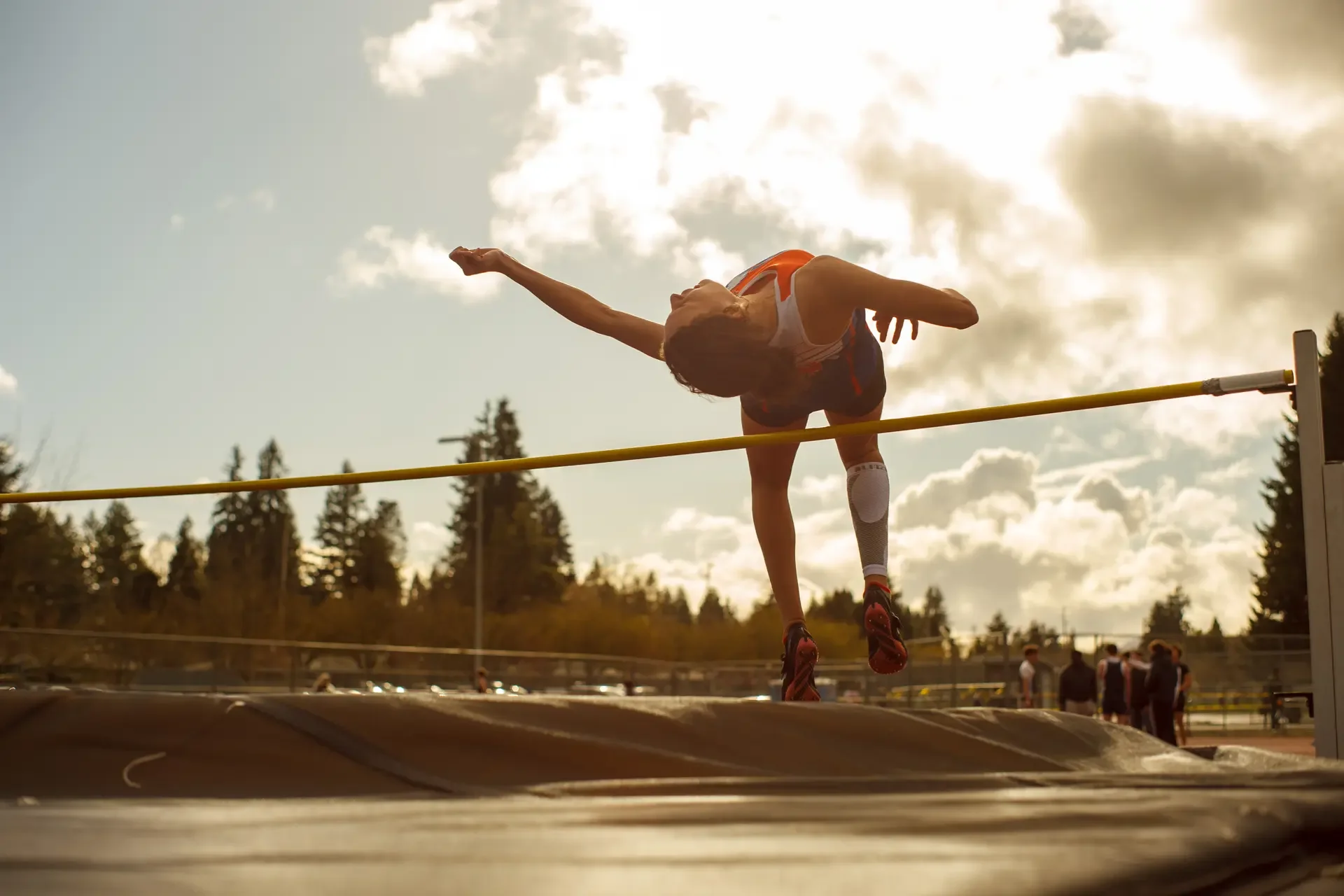
I fired 230 times. I kept 33 frames. But the soul in those 33 frames is undeniable.
When I finally ingested the files, the warmth, the grain, and the analog imperfection hit me. It was exactly what I needed. Out on the track, doing the hardest possible version of my job just to see if I could, the perspective shifted.
Leah Hannen high fives a teammate prior to the start of the 3200m race at Olympia High School in Olympia, WA. Commercial sports and editorial photography engineered by Russell Moore Photography in Olympia, WA.
I know I don’t fit into a safe, traditional package. My work isn't for everyone. But what started as a day defined by someone else's rejection ended with me fiercely appreciating my own vision. I will keep documenting the grit, the effort, and the amateur ritual—on my own terms.