Commercial Photography Licensing & Usage Rights, Explained Simply
Quick answer: In almost every commercial photography arrangement, the photographer retains copyright and ownership of the raw and final image files. What the client receives is a license — permission to use the images in specific ways (web, print, paid ads), for a specific duration (often unlimited, sometimes time-limited), within a specific scope. The license terms, not file ownership, are what actually matter to your business.
This is general information about how commercial photo licensing typically works, not legal advice. Your specific contract terms govern your specific rights — read them, and involve an attorney for anything high-stakes or ambiguous.
The terms that actually show up in a usage license
Scope of use — web, print, paid social/display ads, billboard, packaging. Broader scope generally costs more, because broader use creates more value for the client.
Duration — perpetual/unlimited use is common for brand photography; some arrangements (particularly stock-style or model-release-sensitive shoots) are time-limited.
Exclusivity — whether the client has exclusive use, or whether the photographer can also license the same images elsewhere (this matters more for stock-style work than custom brand shoots, where exclusivity is typically assumed).
Modification rights — whether the client can crop, recolor, or otherwise alter the images, or whether they must be used as delivered.
Sub-licensing — whether the client can hand the images to a separate ad agency or vendor to use on their behalf.
U.S. Copyright Office: Photographers
Want to read the exact federal statutes on image ownership? Skip the blog summaries and reference the actual U.S. Copyright Office guidelines regarding copyright registration and protections for visual artists.
Read the Federal GuidelinesWhy the client doesn't usually own the raw files — and why that's normal
This trips people up, but it's standard across the industry: the photographer is licensing a usable product (edited final images, in a defined scope), not selling raw production materials. Compare it to hiring a contractor — you own the finished kitchen, not the contractor's tools and material offcuts. If a specific project genuinely requires raw file ownership (rare, but it happens — some legal or insurance documentation contexts), that needs to be negotiated and priced before the shoot, not requested afterward.
What happens if you use images outside the licensed scope
Technically, using a web-only licensed image in a national print ad campaign is a license violation — practically, what happens next depends entirely on the photographer and the relationship. The clean way to avoid the conversation entirely: tell your photographer up front everywhere you might want to use the images, even speculatively, so the license is scoped wide enough from the start rather than renegotiated later.
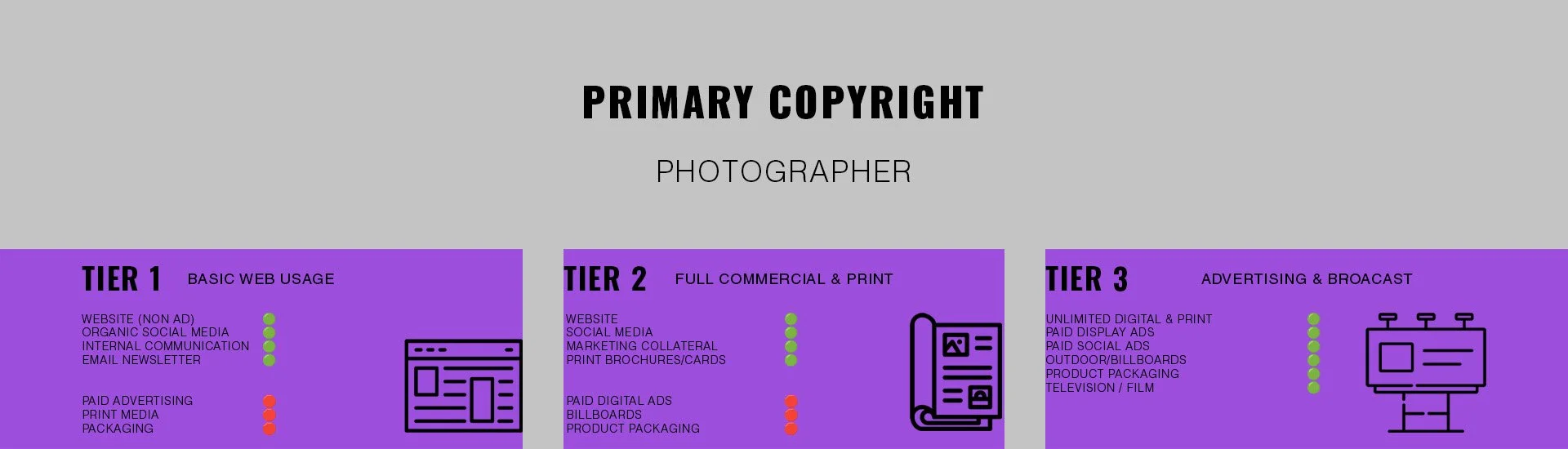
Standard commercial licensing tiers. If you anticipate needing assets for print or paid digital ads, it is always more efficient to negotiate a broader scope (Tier 2 or 3) before production begins rather than retroactively upgrading a basic web license.
FAQ
Do I own the photos after I pay for a photoshoot?
Generally, no. The photographer retains the copyright to the images. What you are paying for is a usage license that grants your business permission to use the photos in specific ways, rather than purchasing the underlying intellectual property or the raw files.
Can I use my brand photos in paid social ads if my contract only mentions "website use"?
If your contract strictly specifies "website use," running those images in paid social or display ads falls outside your current agreement. You will need to contact your photographer to negotiate a license expansion to cover paid advertising, which typically involves an additional fee.
What happens if my usage license expires and I'm still using the photos?
Continuing to use photos after a time-limited license has expired is technically a copyright infringement. To keep using the images legally, you must reach out to the photographer to renew or extend the license.