Year in Review 2025–26
Olivia Decker
Shorewood High School — Cross Country & Track
The Story So Far
Olivia Decker came into the spring season as a 1600 runner. Her coaches had other plans. What followed was an education in patience — hard-earned through Oregon Relays competition, a health setback that cost her races before she even knew about it, and a WIAA State Championships 3200m that looked nothing like the ones she ran in early spring. By the end, she didn't just run the event her coaches put her in. She owned it.
Spring 2026 · WIAA State Championships
Before the Gun
Early in the season she ran the 3200 the only way she knew how: like a 1600 with extra suffering tacked on. All out through the first half, then hold on. She describes not being pleasant to be around on race days. The anger wasn't wasted — it just needed a different address.
At Oregon Relays she learned what a truly competitive field looks like up close — and that the only way to survive it is to stop watching the other lanes and get into your own mind space. That lesson traveled with her to Mount Tahoma.
Spring 2026 · 3200m
The Event She Didn't Want
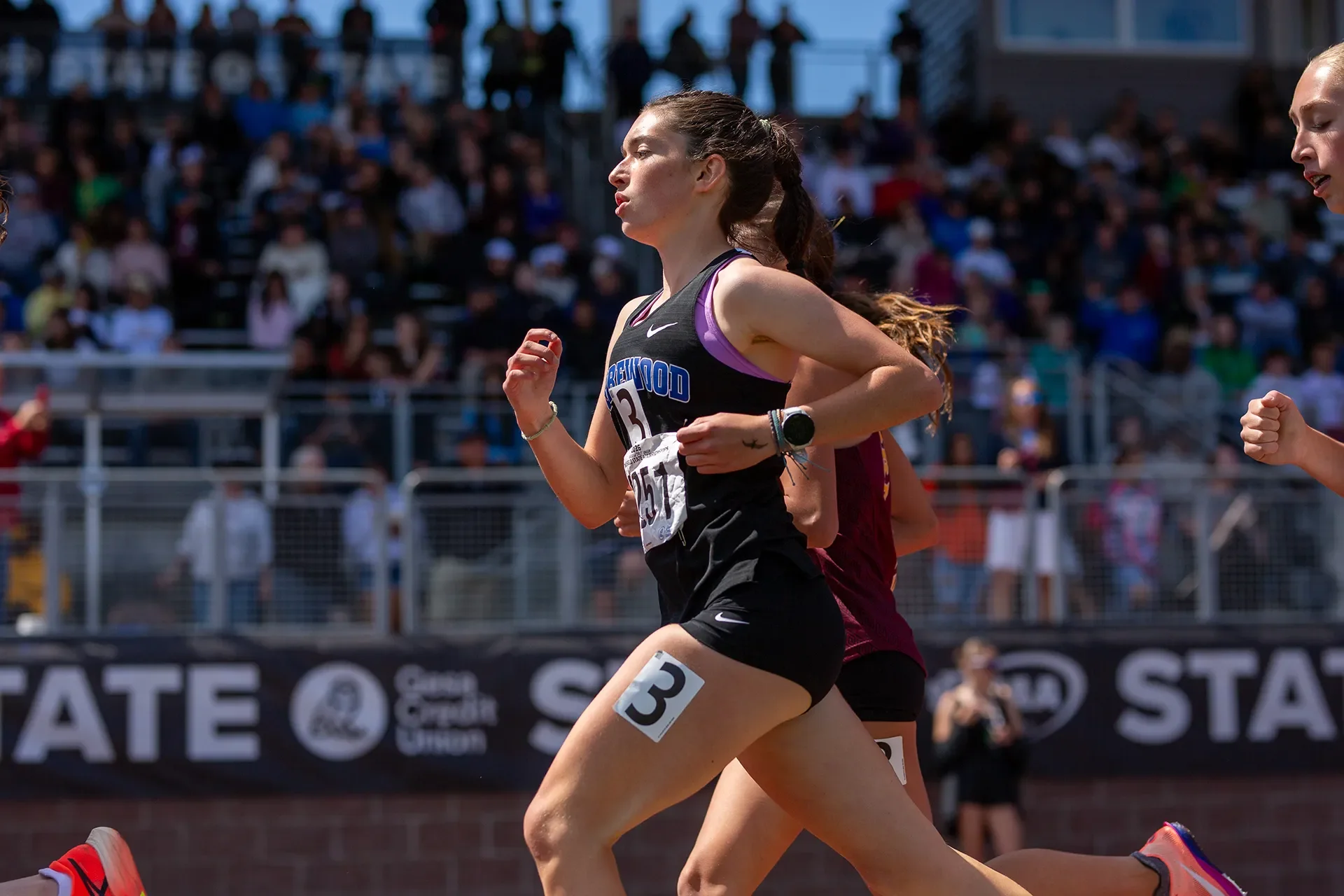
The correction came gradually. Stay conservative. Read the pack. React to what's in front of you instead of trying to outrun what's behind you. By the time state arrived, patience wasn't a race plan anymore. It was muscle memory.
01 3200m pack tactics — Mount Tahoma Stadium, May 30, 2026
Her coaches knew she was a 3200 runner before she did. She's grateful she trusted them. Experimenting is how you find the event that fits — and sometimes the one that fits is the one you fought hardest against.
02 / 03 Personal record, 3200m — WIAA State Championships, May 30, 2026
In Her Words
Q — You came into the spring as a 1600 runner. How did your relationship with the 3200 change over the season?
In the beginning of the season when I first started running the 3200 I just remember despising it. Because all I wanted to run was the 1600 and on the meet days when I ran the 3200 I was not the most pleasant person to be around. Because of that, I typically ran with a lot of anger and frustration. I treated the 3200 like a 1600 — I would go all out the first 1600 and then hold on for dear life. Later in my season, though, I stayed more conservative and then kicked at the end reacting to the pack's movements. In this race you have to be patient, which if I had learned sooner, maybe I would've enjoyed it a little bit more early on.
Q — Oregon Relays puts you in a lane with some of the most competitive distance runners in the region. What does racing at that level teach you?
I would say that Oregon Relays exposes you to what a really competitive and aggressive competition field looks like. When it comes down to it, you really just need to get into your own mind space. You can't let other athletes on the line get in your head. Don't worry about what spikes they're wearing or what school they're from — just run.
Q — Your coaches believed in the 3200 before you did. Was there a moment you realized they were right?
I believe my coaches knew that I was going to be better at the 3200 than the 1600 before I did, and I'm really grateful to have trusted them. Experimenting and trying new events is the best way to understand different dimensions of the sport.
Q — What would you tell a distance runner heading into next season — or the version of yourself at the start of this one?
Training pays off, and not only physically prepares you but mentally as well. It gets you ready to do the hard workouts, the tough races, and it gives you time to experiment with different fuel techniques. Also — get your iron and ferritin checked. If I could go back and get it checked before cross country, I would. It would've saved me a lot of time and a lot of rough workouts, tears, and races.