Season Feature — 2025–26
Curtis High School · Distance Runner
ASHER
PEPIN
From a sub-four 1500m under the lights to a District double that punched his ticket to State.
Preseason · Summer 2025
The Miles Nobody Sees
Long before Districts, before the relay under the lights, there were just the miles. Asher Pepin's junior breakout didn't begin at a championship meet — it began in the unglamorous repetition of summer training with his Curtis teammates: the early starts, the long aerobic runs, the work nobody is watching. It's the kind of foundation that never shows up on a results page, but without it, none of what followed happens at all.
Cross Country · Fall 2025
Building The Base
By fall, the summer work was paying dividends. Pepin lined up for Curtis at the Westside Classic and the SPSL 4A League Championships, racing varsity against some of the region's deepest fields. Cross country is where instinct gets built — reading a pack, knowing when to move, trusting a kick that hasn't been tested yet. Those instincts would matter more than he knew once track season arrived.
Track & Field · Spring 2026
The District Double
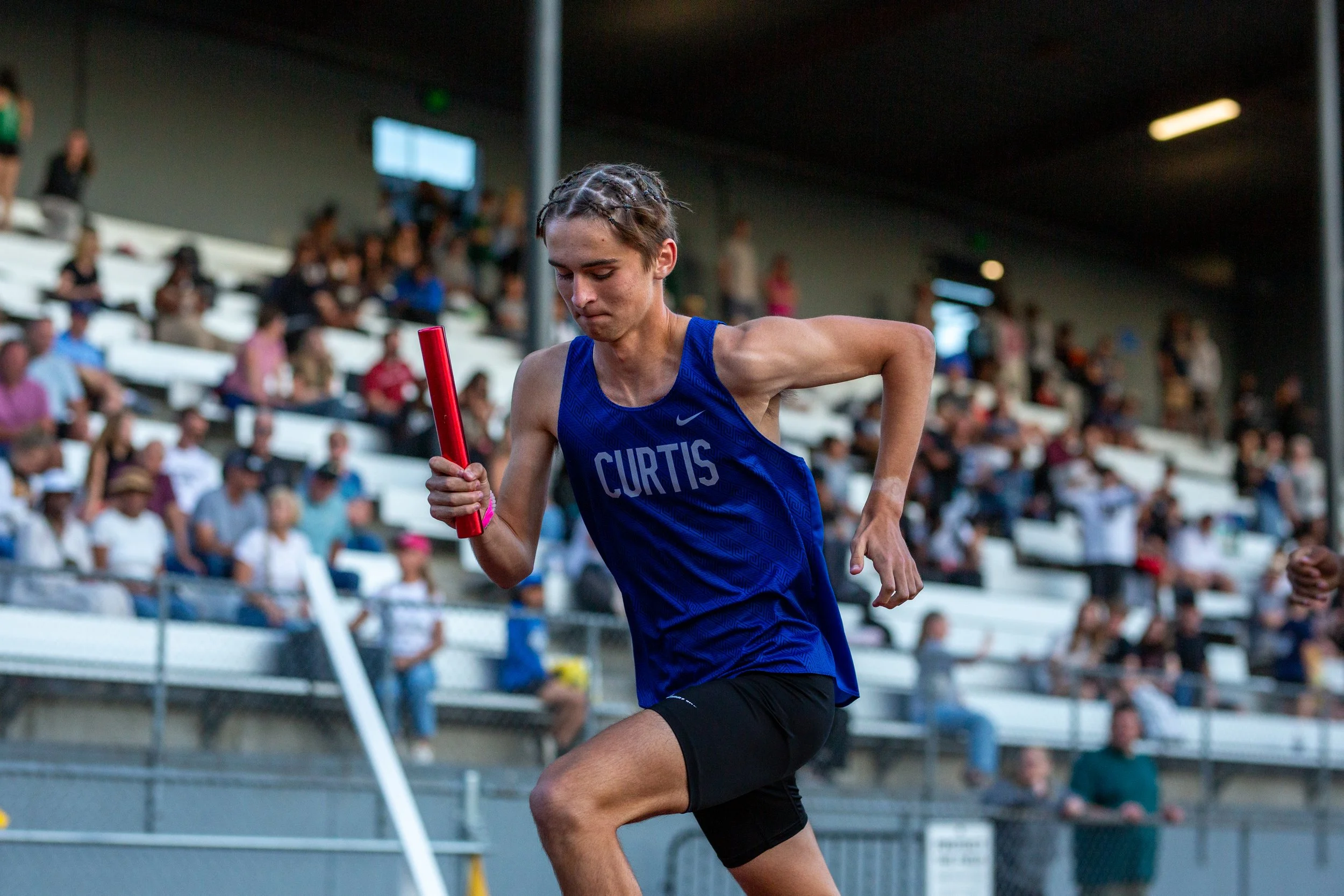
Pepin's spring came down to two numbers: 4:10.89 and 1:55.75 — his 1600m and 800m times at the District 3/4 Championships at French Field, a double that punched his ticket to State. It capped a season that had turned a corner weeks earlier at the Nike/Jesuit Twilight Relays, where he broke four minutes in the 1500m for the first time, running 3:58.15 under the lights. Both performances trace back to the same decision: stop hesitating, and race like he belonged in the pack he'd been chasing all year.
All week I thought about what would happen if I just went for it and didn't think twice — so that's exactly what I did.
— Asher Pepin
In His Own Words
The Full Conversation
Q1You peaked perfectly during the postseason, hitting a 4:10.89 in the 1600m and a 1:55.75 in the 800m at the District 3/4 Championships at French Field to punch your ticket to State. What clicked for you physically and mentally during those two days of racing?
Going into Districts I knew that if I wanted to make it to State, I'd have to break through some barriers I'd been having all season — like not being afraid to make moves and run with the top pack. All week I thought about what would happen if I just went for it and didn't think twice, so that's exactly what I did. On the line, I put myself in about fifth place, and through the whole race I made sure I stayed within the top six. It ended up working out really well.
Q2Breaking the four-minute barrier in the 1500m (3:58.15) at the Nike/Jesuit Twilight Relays under the lights is a major milestone. Walk me through that race — at what point did you realize you were on pace to hit that mark?
That race was probably the turning point of my season. Going in, I hadn't been hitting very impressive times and knew I needed a good one. I was really focused on getting under four minutes, so during the race I paid close attention to my splits and made sure to push to stay with the pack. Honestly, even when you're paying attention to splits, it's hard to know exactly what you're running when you're pushing that hard — usually the last 100 meters is where I really know what I'm going to finish in.
Q3You raced in some massive, elite fields this year — from New Balance Nationals Indoor to the South Sound Classic and the 4A State finals. How has your tactical approach to navigating physical, high-stakes races evolved throughout your junior campaign?
During indoor season I really felt no pressure, since there wasn't an end goal of State in mind — I was just seeing what I was capable of. Going into NBIN we had some travel issues; my flight got delayed six hours and we were stuck on the ground for hours, which really affected my body going into those races. I think that failure in Boston made me strive even harder for success outdoors. Every week I focused on hitting exact paces for workouts and trusting my coaches' plan. I knew going into the year that I needed to race the 3200m, and I'd only done it in dual meets where I was pacing or sick — so at South Sound I knew it had to be my best race. I focused on even splits, and my coaches calling out my 400 splits really helped mentally and let me get a big PR. This year taught me not to be afraid of pushing in races, and that every failure or bad race is a learning opportunity to get better and improve mentally.
Q4With your senior year coming up, you'll be stepping to the line as one of the top veterans in the state. What are your primary training focuses as you transition from a junior-year breakout into a senior leadership role?
Going into senior year, it's important that I hit every workout with the best effort I can give — not over- or under-doing it. This summer, the most important thing I can do as an athlete is follow my coaches' plan to a tee. I know what I need to do to get better, and I'm ready for the work it'll take. One thing my teammates know about me is that I'm not afraid to talk to people on the line — before every race I chat with my competitors, even people in other races, just as friends. I think it's important to remember that on the track we can be competitive and rivals, but off the track we can be friends, support each other, and make the running community stronger.
On the track we can be competitive and rivals — but off the track we can be friends and support each other.
— Asher Pepin
Update — his senior season is already underway: read the senior portrait session →